|
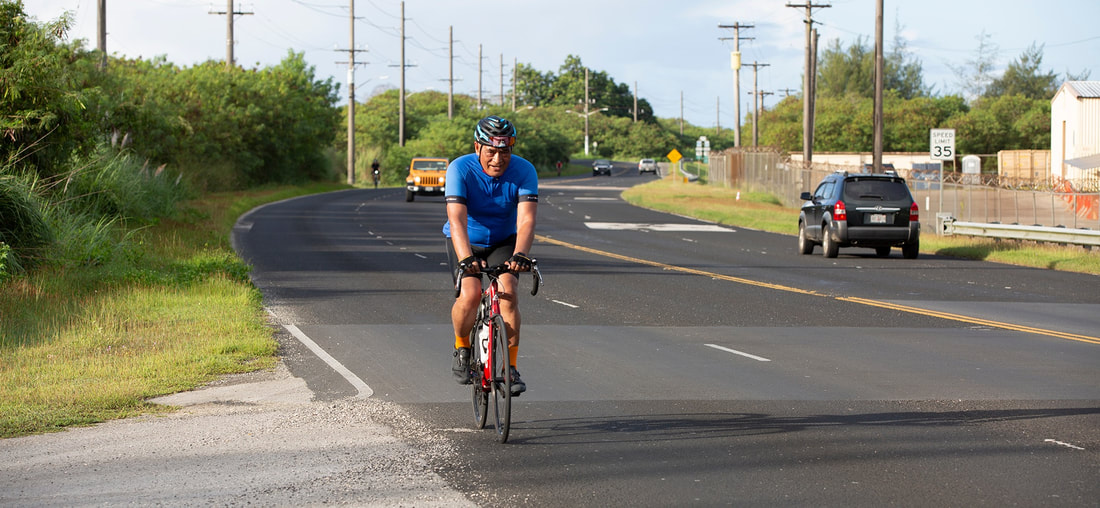
Looking back to 2014 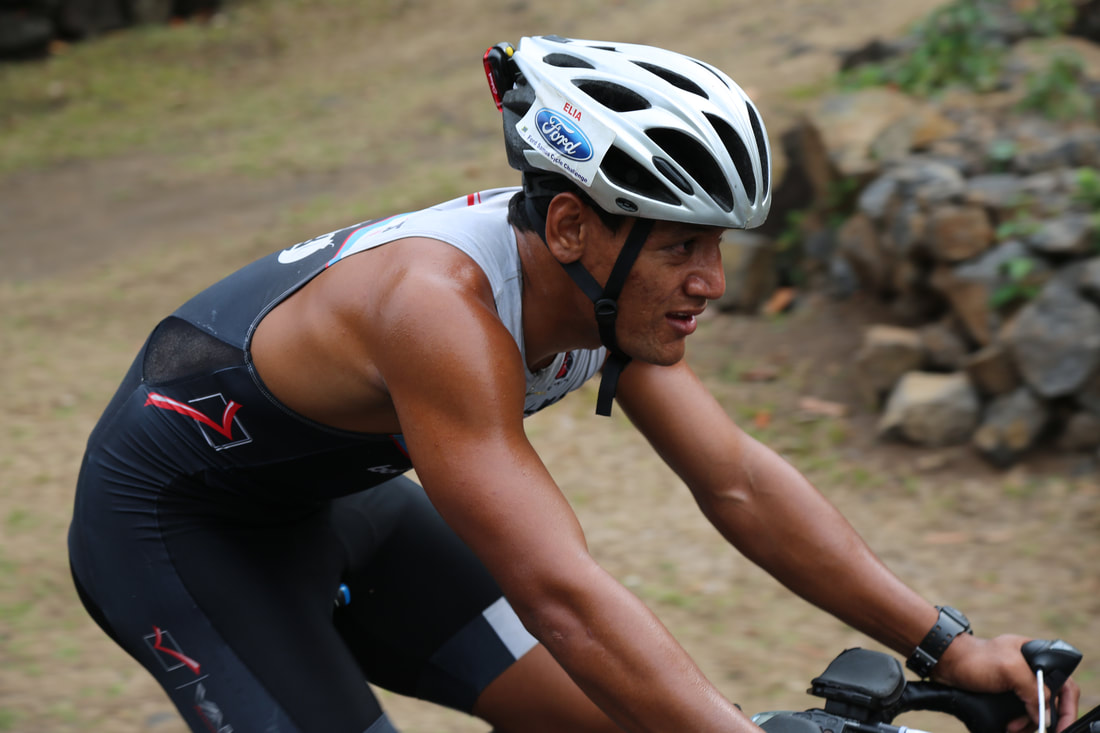 Elia Lasa has achieved what no one else in Sāmoa has done before. On Tuesday at 7:30 pm, the rider from Falefā village in Anoama’a East completed a cycle ride around Upolu and Savai’i in less than 24 hours. He can now rightfully claim the title of Sāmoa’s Supreme Cyclist of the Year award, and no one will dispute it. He is the Lance Armstrong of Sāmoa Cycling, but without the use of drugs.
The gruelling challenge involved covering 370 km of tough riding on two islands, navigating rough surfaces, facing numerous dog chases through the night, taking two ferry rides, enduring extreme heat, conquering steep hill climbs, all with hardly any sleep. This achievement comes just over two weeks after completing the Ford Samoa 3-Day Cycle Challenge (later to become the Tour of Sāmoa). During that event, Elia was one of three riders to complete the 3-Day event, covering a shorter course of 356 km and finishing in third place. However, the difference this time was that Elia rode non-stop over a longer distance, all within a single day. He was the sole survivor until the end. The 24-Hour Challenge commenced on Monday night at 8:30 pm at the Apia Town Clock. Twenty-three hours later, at 7:30 pm on Tuesday night, Elia returned to the same spot after circumnavigating Upolu and Savai’i. On Monday night, three riders - Li'ali'aalefao Daniel Afoa, Dave Leng, and Elia Lasa - set off from the Town Clock and rode clockwise around Upolu. As people retired for the night, the riders quietly pedalled through darkened villages, displaying remarkable determination. I followed them in the support vehicle on high beam to illuminate their way. At 11 pm, we reached the summit of Le Mafa Pass. At 1 am, we took our first break at Lalomanu outside Aga Resort. It was a chance for the riders to refuel, eat, check their bikes, replenish fluids, and then continue the journey. We rode non-stop from there to Mulifanua wharf via Faleālili and Lefaga, arriving at 3:15 am. It was a remarkably fast pace. We lost a rider there (Leng), but two continued on to Savai'i for the arduous task ahead. We made further preparations at Mulifanua, including a cold wash, changing clothes, consuming food and fluids, and then some sleep before the 6 am ferry. The crossing on the slow ferry allowed more shut-eye for the riders. It was surprisingly faster than usual, which worked in our favour. Once on Savai’i, Daniel and Elia, both from Falefā, got back on their saddles and rode clockwise around the big island. The key to completing the challenge was reaching Sālelologa by 4 pm to catch the ferry back to Mulifanua. The plan was to reach Āsau by 11:30 am, Sāleaula by 2 pm, and Tuasivi by 3:20 pm, ensuring they made it to the ferry before 4 pm. We reached Āsau right on time at 11:30 am, after covering 95 km of continuous riding without a break. The decision to take the clockwise route was made carefully by Daniel, simply to avoid a long ride into the headwind late in the day if they had gone the opposite way. Although there was still some headwind on the Itū o Tane side, it offered more natural buffering from the wind. The ride to Āsau via Gataivai and Itū Sālega presented its own challenges. The first 20 km were very rough for the bikes, as the road seal disappeared. Then came the climbs at Sālega and Falelima. However, these challenges were offset by the long descent down the hill at Papa Sātaua. This descent was another reason for choosing this route, as it avoided the long climb from Papa to Faleālupo going the other way. Upon reaching Āsau, we rested by the village pool. Daniel and Elia immersed themselves in the cool village pool of natural spring water; refilled their water bottles, ate more food, donned new riding gear for the next leg, and restocked on gels and salts for the upcoming hills. The equation now was to cover 85 km in 3.5 hours, which was doable under normal circumstances. However, it was exceptionally hot, and the rising hills between Asau and Aopo posed a significant challenge. Despite the gains made by reaching Āsau on time, these were quickly lost on this leg. Daniel and Elia were beginning to feel the strain, much like poorly maintained machines. They had to take regular unscheduled breaks, consuming ice and gels in large quantities. However, these were only temporary solutions, as their bodies protested against the abuse inflicted on already aching limbs. Time was now of the essence, and it was slipping away rapidly. It was agonising to follow the riders in the support vehicle, especially during the steep and slow climb from Āsau. We limped tenderly to Āopo, and even the downhill ride from there was slow, as their sore bodies could not fully take advantage of the descent to Sāsina. Elia was in physical pain from tight leg muscles, so much so that I offered him a ride on the back of the support vehicle for the rest of the journey through Savaii. He looked at me with a pained expression and shook his head. He was determined to continue. We had 70 km to go and only 2.5 hours to reach our destination. Daniel still believed that they could make it to the ferry by 4 pm. However, we needed to pass Tanu Beach by 1:45 pm and be at the 35-km mark with 90 minutes to spare. Elia and Daniel were on pure survival mode, and it was remarkable that they reached the designated waypoints in those timeframes. At the three corners at Sāmalaeulu, with 35 km to go and 90 minutes left before the ferry, Daniel was confident they could make it. On all accounts, Elia was lagging behind Daniel by up to 2 km at times. Nonetheless, he continued to pedal on as though his life depended on it. Then, we needed to reach Puapua in 30 minutes and have an hour left to cover the last 20 kilometers. It was a challenging task, but Daniel was surging ahead while the support vehicle stayed with Elia. The focus was on getting Daniel to the ferry, with the plan to pick up Elia if he got too close to 4 pm. Then, the unthinkable happened at Puapua - Daniel, the leader, was physically incapacitated by his own cramps and could not continue, no matter how hard he tried. His ride was over. Elia, riding like a robot, continued to ignore the pain. With Daniel out of the ride, our focus shifted to getting Elia across the finish line. He rode past Lano and then Faga. With twelve km to go and forty minutes remaining, we left him with a pep talk and a cold can of Coke for a sugar rush. "You can do it! Only 12 km to go, which is the distance from Solosolo to Falefā, and you have to do it in under 40 minutes." With those instructions, we took off to secure our vehicle's berth on the ferry, placing all our faith in Elia to reach the ferry before it sailed at 4 o'clock. The support vehicle was on the ferry, and all we wanted was for Elia to arrive quickly. Ten minutes before departure, there was no sign of him. We explained the situation to the ferry personnel, but they insisted the ferry would sail at 4 pm. Still no sign of Elia with 7 minutes to departure. Then, we spotted him, riding like a robot but with speed toward the wharf. He had done it. He made it with six minutes to spare. Once he was on the boat, the bridge was drawn, and the ferry set off before 4 pm. The ninety-minute ferry ride to Mulifanua provided Elia with much-needed rest. He still had 35 km to ride once we landed on Upolu, with the finish line at the Apia Town Clock. Daniel was exhausted, and with his ride ended, the new plan was for him to join Elia closer to town for the final ride to the Town Clock. Upon landing, both Daniel and Elia suited up and rode at a slow pace for the last 35 km. They rode like novice riders, battling fatigue, tiredness, and a stiff headwind. Despite the challenges, they inched closer to their goal. Finally, we reached Apia, and the sight of the Town Clock from Taufusi brought welcome relief. We were home. The time was 7:30 pm. Elia completed the challenge in 23 hours, achieving the seemingly impossible. Throughout the journey, there were numerous other challenges and obstacles. During the night on Upolu, packs of dogs in almost every village gave chase. Potholes filled the roads in many places, making the riding conditions exceptionally tough. However, the biggest challenge lay ahead on Savai’i. The long, steep hills of Sālega, Falelima, Āsau to Āopo, and the stretch between Sāmalaeulu and Puapua began to take their toll on the riders. Add the intense heat to the already challenging equation, and it made for incredibly tough riding conditions. Elia overcame all these obstacles, and his supreme achievement rightfully earns him the title of the undisputed long-distance cyclist in Sāmoa for 2014. He deserves recognition and reward for his courageous and fearless mindset. Elia faced physical troubles with back pain throughout the ride, yet he refused to give up. After the ride, he said, "My back was very sore and it was hurting me badly, but I did not want to give up. I wanted to complete the challenge." "Once Daniel was out, I wanted to make sure I continued, otherwise the whole exercise would have been in vain with no one finishing the challenge." We were fortunate not to encounter any punctures or mechanicals on the entire ride. This humble village kid has accomplished what no one else has done before, and it will be a long time before anyone else can complete this challenge, let alone attempt it. The recognition as the Supreme Cyclist, if not in all of local sports, is undoubtedly his for this year. All Hail Elia Lasa! Elia would complete this challenge for a second time in 2015 with Daniel and Darren Young as new finishers of the 24-Hour Cycle Challenge. The ride has not been attempted since.
0 Comments
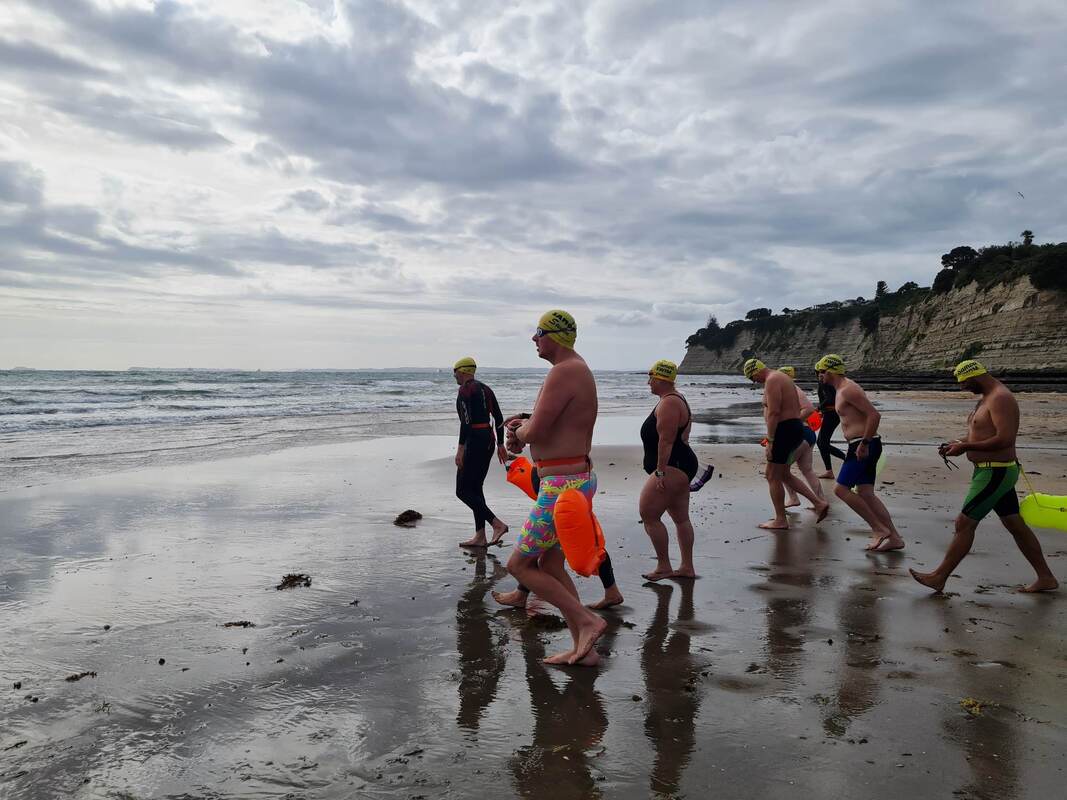
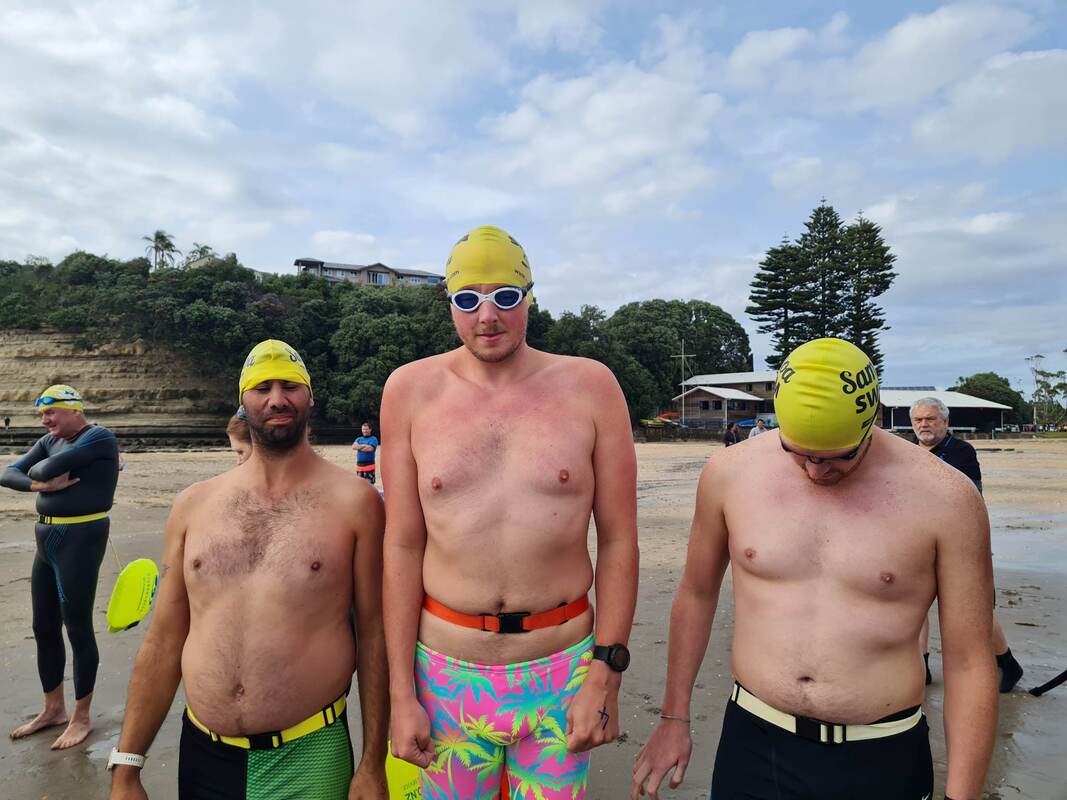
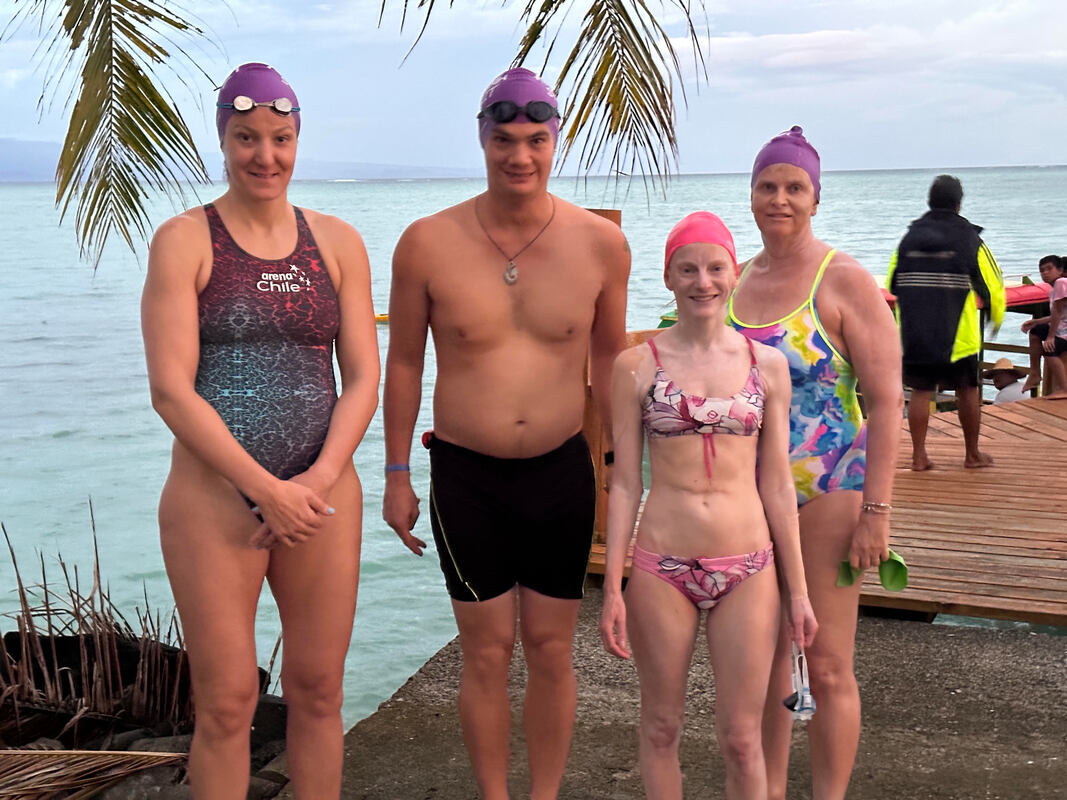 Photo: Ruth Mariñosa, Samuel Muir-James, Jessica Campbell, Melissa Donaldson at the start of the swim at Mulifanua, Upolu – Samoa Events On August 7th, four swimmers Ruth Mariñosa, Samuel Muir-James, Jessica Campbell and Melissa Donaldson successfully completed the crossing of Apolima Strait in Sāmoa. It is the first time in four years the swim has been completed. The Strait is a 22.3 km stretch of water between the islands of Upolu and Savai’i. Mariñosa and Muir-James attempted the crossing a few months earlier in May which was abandoned due to heavy seas. Mariñosa, a Spanish national living in Tāmaki Makaurau Auckland, Aotearoa New Zealand was the first to cross the finish line at Sālelologa, Savai’i. Muir-James now adds Apolima Strait to his other ultra swim achievements, Cook Strait and Lake Taupō in Aotearoa, NZ. His next goal is to swim Foveaux Strait to complete the NZ Triple Crown. Jessica Campell had a great swim and is the first UK national to swim Apolima Strait. Melissa Donaldson was guided by marathon swim Master Coach Tracey Baumann on the kayak. Husband Geoff was also on the paddle assisting with the transfer of nutrition from the support boat to Melissa. Donaldson is a director and coach at At One Swimming in Brisbane Australia. On the day of the swim, weather conditions got better as the swim progressed. Rolling seas on the entrance to Sālelologa harbour made the final approach interesting for supporting vessels that included the Sāmoa Maritime Police Nāfanua rescue boat with Police divers onboard. Mariñosa, Muir-James, Campbell and Donaldson are the 26th, 27th, 28th and 29th swimmers to swim Upolu to Savai’i. The next Apolima Strait is Wednesday 1st May 2024. Entries are now open. There is also a four-person teams’ relay on Saturday 3rd August at the end of the Sāmoa Swim Series 2024. END 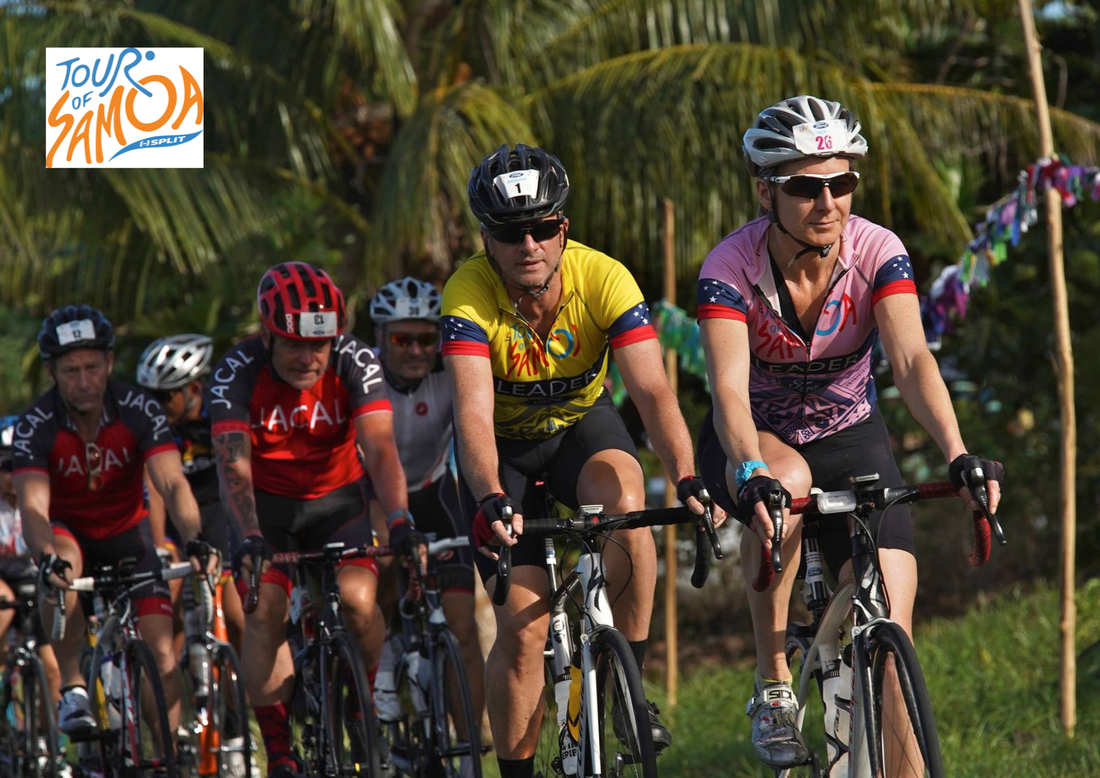 Tour of Samoa 2018, Men and Women's tour champions Brendon Madden-Smith and Nicki Sutherland leading the charge in the 100km Challenge on day four of the tour Tour of Samoa welcomes the exciting new partnership with Negative Split Carbon as the naming rights sponsor for the 2023 tour. It is the first time in the seven-year history of the tour to partner with an offshore company. The relationship between the tour and Negative Split Carbon was first formed in 2018 when Oceania GM Chris Dunn travelled to Samoa with his wife Rachel to compete in the Samoa Swim Series, a sister event to the tour. Chris and Rachel enjoyed their Samoa experience so much that they were back the next year. Chris won the Samoa Swim Series and Pacific Open Water Championship in his second year, and also won the Warrior Race Beat the Heat standard distance triathlon. In 2020, the Dunn’s invested in Negative Split Carbon Oceania and became the distributors for the region. Negative Split Carbon was founded in New Zealand in 2018 and specialises in Carbon wheels for road, triathlon, gravel and cross-country cycling. 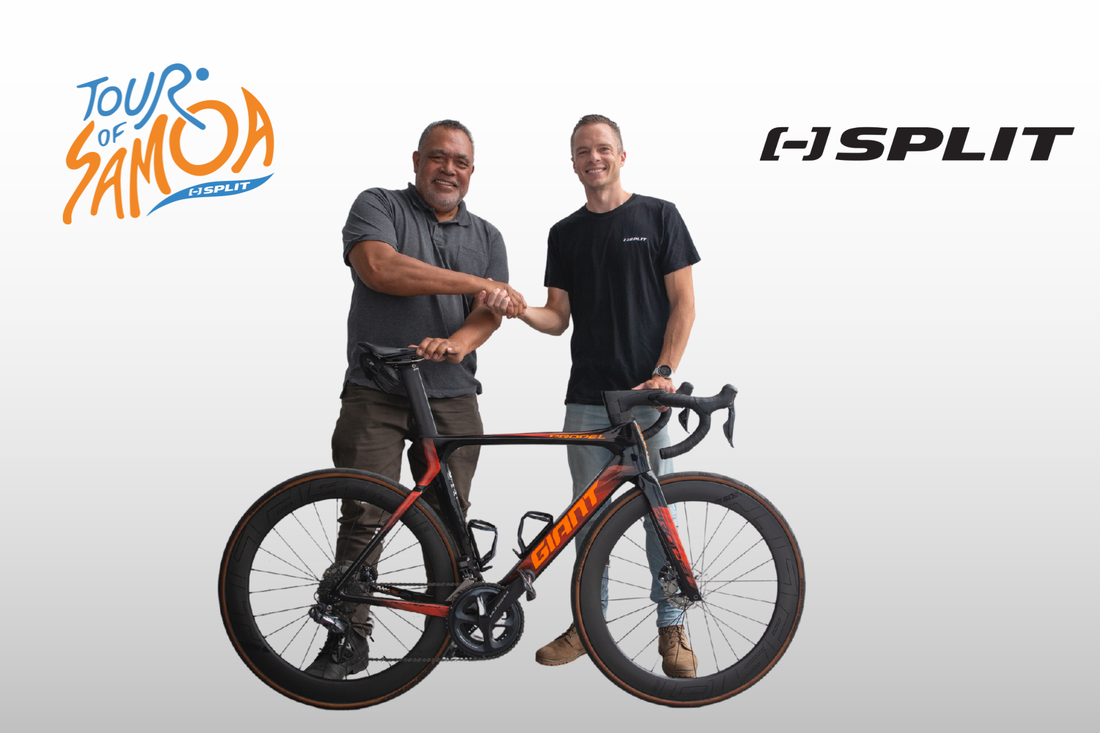 Tour of Samoa Director, Seti Afoa and Oceania Negative Split Carbon General Manager, Chris Dunn The opportunity to be a commercial partner with the tour fits with Chris’ love of triathlon and cycling, establishing a new Bike wheel business and competing in Samoa. “We are very excited to be partnering with the Tour of Samoa in 2023. In my opinion, it’s the only true tour in the South Pacific because riders get to see the whole country throughout the course of the event. NSC's mission is to make carbon wheels more accessible for riders so partnering with an inclusive and accessible event like the Tour of Samoa is a perfect fit. Most riders only get to watch tour racing on TV or from a roadside. Having a tour event, open to all riders creates an incredible experience that we can’t wait to be part of." “It’s going to be hard decision for us this year to choose between competing in the SSS and the tour. We’ve been involved as competitors in a number of events hosted by Seti and Samoa Events over the past 5 years and continue to come back year after year for the warm Samoan hospitality, incredible scenery and camaraderie amongst the athletes. The most difficult decision every year, is deciding which event to do because they’re all world class.” said Chris. Tour director, Seti Afoa, welcomes the opportunity to work with NSC. “I like Chris’ energy and positive worldview. He understands what we are doing in Samoa. The fact he loves competing here is an added bonus.” “He also knows the market, not only the people in the multisport market but also the equipment needed to do well riding the tour or competing in Warrior in Samoa.” The Tour is an exciting friendly competition for men and women riders of all abilities. Notable from the first tour were the long-term friendships made in any tour of Samoa. This year’s tour will be no exception. Tour Schedule 9 August, 24-Hour Challenge 12 August, Apia Road Race, Criterium 14-19 August, Tour of Samoa 18 August, Savai’i 180 This Press Release was written by Samoa Events. Tour champions Men 2014, Christian Wengler 2015, Christian Wengler 2016, Tim Robertson 2017, Brendon Madden-Smith 2018, Brendon Madden-Smith 2019, Christian Wengler Women 2015, Rebecca Marley 2016, Rebecca Marley 2017, Rebecca Marley 2018, Nicki Sutherland 2019, Dianne Rankin END 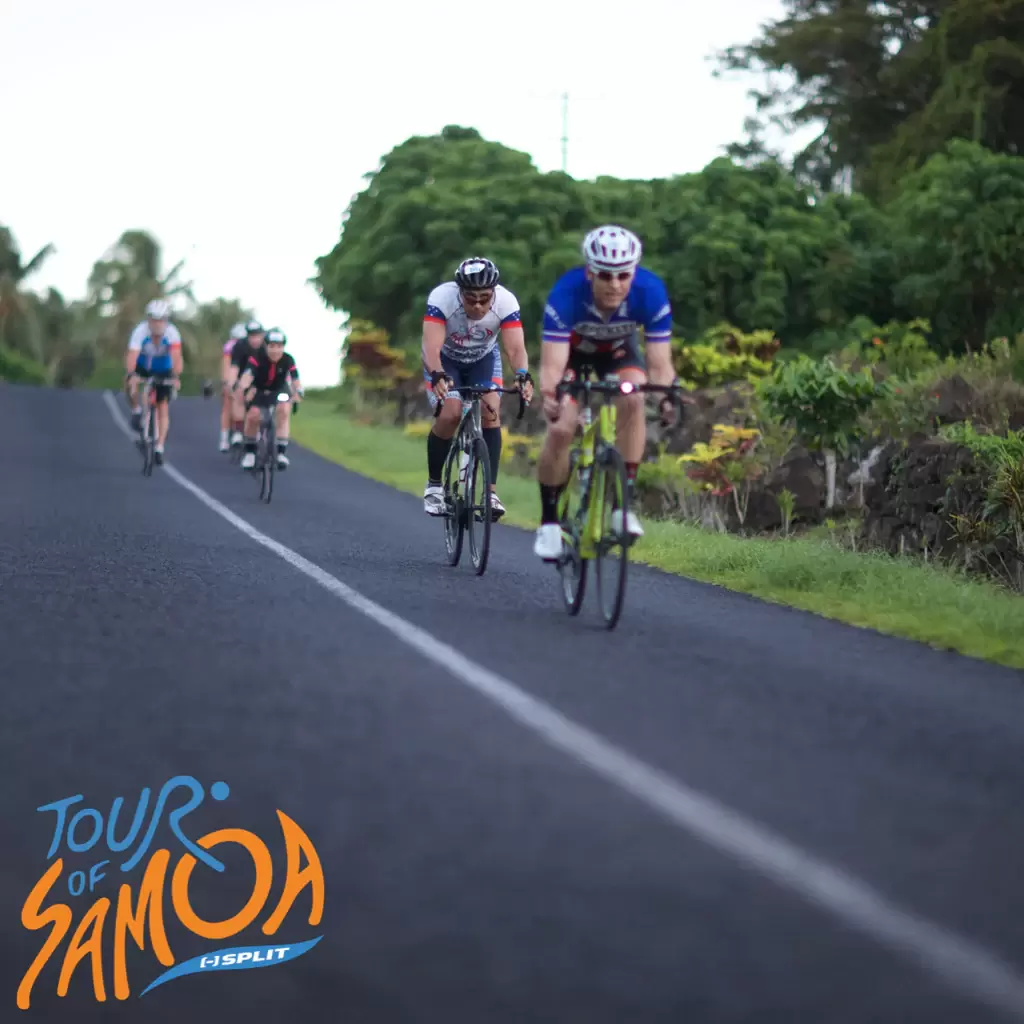 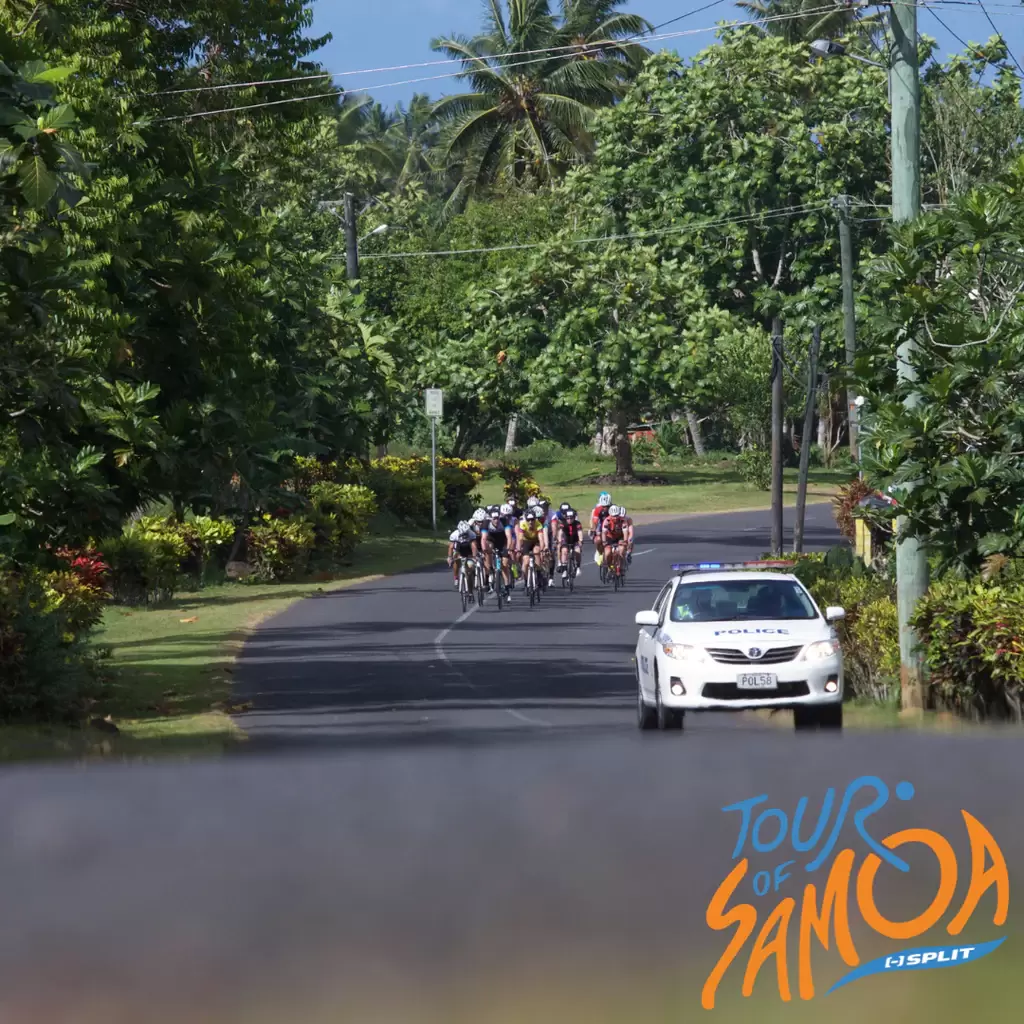 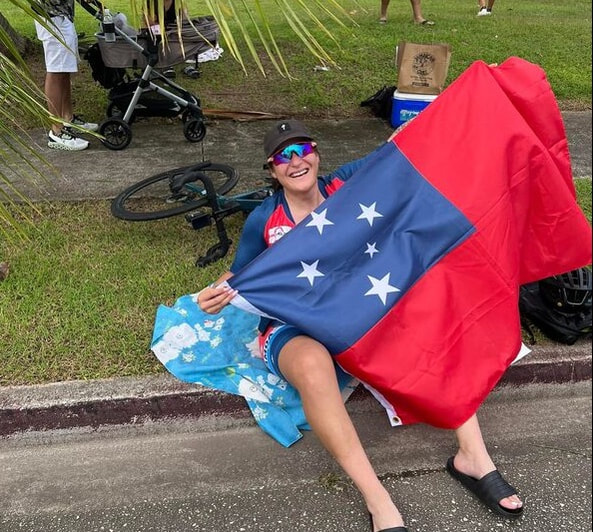 Jasmine at the end of her race. PACIFIC CUP REPORT - GUAM I had no idea what I was getting into… I had no clue. The most common response I got when I told people I was going to race the Pacific Cup in Guam was “where is Guam?” or “oh, it’s an island so it should be all on the beach, right?” Well, to my surprise Guam offers an intense variety of elevation gain, weather, steep fast rolling hills, and a terrain that I can’t describe in detail, only that, you just had to be there. I was offered the opportunity to represent Samoa at the very first Pacific Cup in early October. I made it official with a plane ticket later in the month with solid plans to race on December 11th. Within a short amount of time to prepare mentally and physically, I studied the course, and I searched social media platforms for previous times and recordings. I tried to track recent times and compared those to my mock-up times. I worked side by side with the Samoa Cycling Federation President Seti Afoa. He offered support over zoom meetings and proper funding, ultimately assisting with my travel. To cover the remaining costs of my trip I was able to work with my family and friends to fundraise through apparel I had designed myself and promoted on my website. I received a lot of support and love from my community, and my colleagues to make this trip possible. I worked with coaching staff Bernie Port to build a race course profile and the most efficient way to approach the race around the island. We spoke about nutrition, positions to maintain, and our overall goal to give the best effort while finishing with the rubber side down and a smile. My teammate Daniel Afoa was by my side in Guam assisting with representation, meals, and transportation. Daniel helped recon the course and helped me understand the geography of the island. We worked together to ensure a safe successful trip. I arrived in Guam on Wednesday, December 7th, giving me just a few days to assemble my bike from international travel and acclimate to the beautiful humidity of the island. My spirit was high and I was excited about the main event on Sunday. I enjoyed the wonderful beaches of Tumon Bay, also the friendly staff and people at The Pacific Island Club, the hotel that hosted my stay. I was able to get fast service for my bike at a local bike shop called BikeFixGuam. A familiar atmosphere for me where Derek and his wife Monessa helped me feel very welcome and comfortable by letting me use their service stand and tools. I was blessed with the accessibility of their shop, which made me feel safe and confident that my bike was ready to ride for the race. 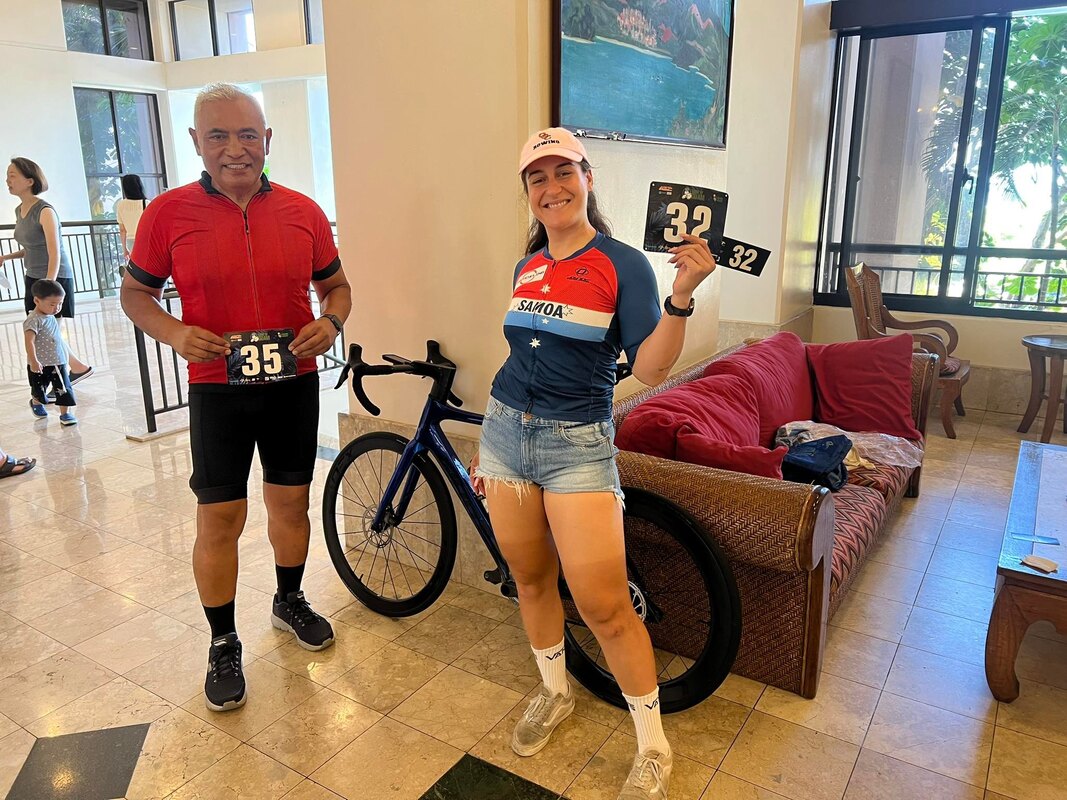 Team Samoa - Daniel and Jasmine the day before the race In preparation for the big day, coaches and competitors met to go over the official rules with the UCI. The key points of this meeting included areas to be aware of, support vehicle rules, and the other races happening alongside the Pacific Cup. Tour of Guam and their National Championships would be happening as well, meaning there would be about 200+ riders on the course. The Pacific Cup would get a 5-minute head start on the Tour of Guam. Results would show the Elite group and then the riders participating in the tour. For some, this caused some confusion, but for me, it offered a good mixture of riders. This also helped with direction on the remote sides of the island where there were no volunteers or aid stations. Since men and women were starting together, there was no rule against drafting the men or the other riders of the Tour. This is sometimes a rule that is very strict in the case that other categorized races start at the same time. If there has to be an overlapped start on the same course of a race, some categories would be required to neutralize. But in this case, it was everyone for themselves, and later this fact alone made my experience just a little more enjoyable. With just one day to go, at packet pick up I received a goodie bag with Tour of Guam merchandise, a shirt, and a bottle. Also my jersey number, helmet number, and a seat post decal number with a tracking magnet to capture the precise time I crossed the finish line. I always feel excited when receiving jersey numbers and registration packets. I honor those moments when you accept your number and realize, there's no turning back now. I also had this sensation when I purchased a non-refundable plane ticket and traveled 20 hours. But, at this point, it became real, because I was here and I felt blessed and grateful to have the chance to represent Samoa and help push cycling and bike racing forward in the pacific islands. 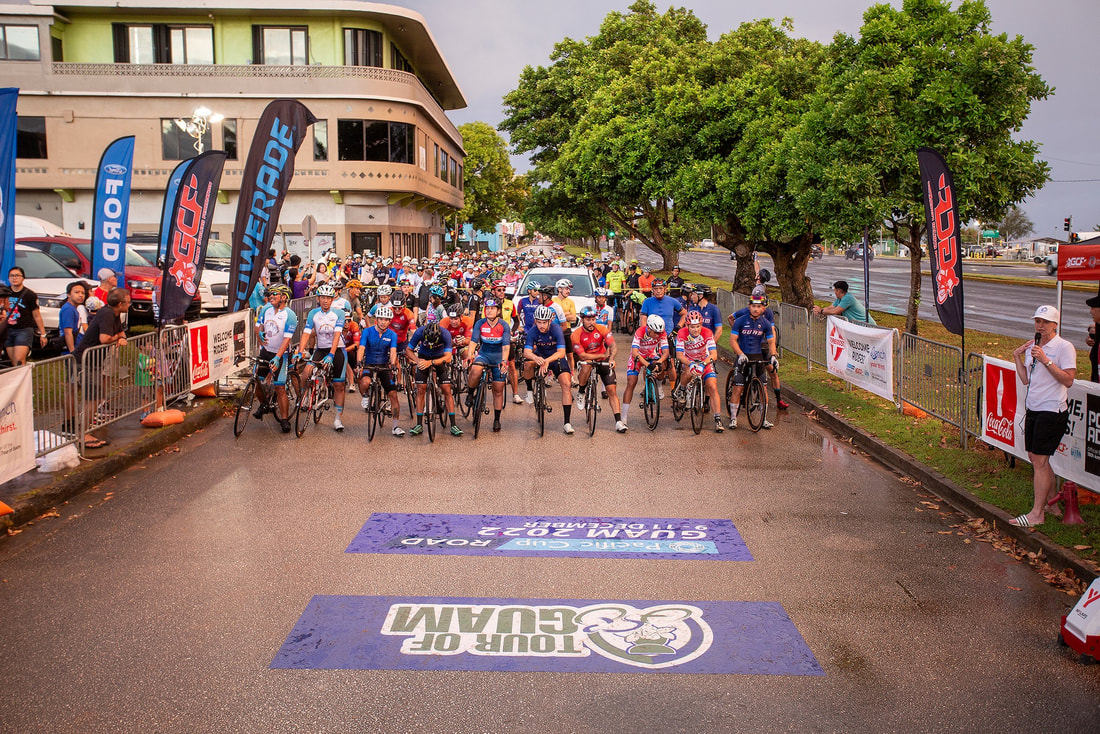 Jasmine is front and centre ready to race. Daniel is on the second row in blue shirt. On the morning of the race, I woke up two hours earlier than I had wanted. I got up and stretched, hydrated, and connected with some family. I had been monitoring the weather every day since I arrived and realized it rained every. day. in Guam. So when there were dark clouds and thick drops around the hotel balcony I reminded myself “this is what I thought.” In racing, there is no way to escape the weather. It just is, what it is. The cool thing about Guam and the Pacific Islands is, that anyone would feel the relief from the rain, for the fact that it offers coverage from the heavy sun rays that in some cases are inescapable. With a start time of 5:30 am, I was out of my hotel at 4:45 am with a 2.5-mile ride to the start line on a drenched road and refreshing thick air. I got a nice warm-up to the start but my socks were drenched. I accepted my fate. It would rain on and off the entire race. If it wasn’t raining on you, it was raining up on the mountain you were descending, and the water was flowing down the hill with you. The race started and I tried to keep track of the women in the first group. I counted 3, and then there was me. I fought to climb with the first group for the first hour and lost them about 7 miles in. I was alone for the first loop of the first section of the course. While on the island crossing road, I heard a sweet voice come around my left side, “Hey, want to draft?” I sat up and caught the gals wheel and she turned around with a plan, “rotate every 20 (pedal) strokes?” I yelled back in slight pain but relief “uhh.. y-yeah !” We worked together for about 20 miles and 2 hours, for a good half of the race through the southern part of the island. We saw two aid stations together and we would root each other through. I would yell “Let’s go girl!” and she would cheer under her breath “go Samoa.” While making our way back north to cross the island for the last time, a few more people passed us and we grabbed their wheel. After about 15 minutes and approaching the last big climb I lost her. I saw her look back and that was the last time we would see each other until the finish. I was hurting, and I was hungry. I was frustrated, soaking wet, and sweating. I couldn’t cry, because my legs had taken over my body. I didn’t have a thought in my mind except “I will not stop.” I was beside myself yelling vulgar things and pressing to get past this dark part. Ultimately I let go of closing gaps, the finish time I was fighting for, and told myself “let’s just get to the finish line.” So the pressure was off, and my body was still in pieces. I was dreaming of spam musubi and mac n cheese. I wanted an entire thanksgiving dinner after it all. I dreamt up food while I sucked down an energy gel and hydration mix, it helped but I could feel my body chopping through the 200 calories quickly and fatigue was the butcher knife. Through the final climb, two gentlemen passed on my left with friendly cheer. “Whoooo! It’s almost finished, you’re almost there!” I asked them if they were from Guam. They said YES! And I told them they must do this ride a lot. “Yes, and it’s tough.” they said. They asked where I was from, and I told them I was representing Samoa in the Pacific Cup. “OHH, welcome to Guam..” they said very warmly. Jasmine on course to complete two laps to finish 5th elite woman in the Pacific Cup. Daniel faced mechanical issues and withdrew from the race after one lap. Results link here. Men’s results here. Finishing at one minute over 4 hours I found a place to lie on the floor away from the crowd. I felt so happy to have finished. I was overwhelmed by the road I had just ridden, with all those kind people. The beauty of the island I zoomed through started to replay in my mind. I broke down into tears. I couldn’t stop crying, maybe because I was holding all these emotions in for the last 30 miles. I just felt so grateful for the good vibes the whole way through. Every person that passed me or looked back was so kind. Every volunteer or bystander that shouted a “CCHHEEHOO” fired me up. Those moments I was alone with just the road, the sounds of the ocean, and the air of the island were incredible. As I was crying to my mom on the phone the woman that had worked with me through the biggest section of that race approached me. Giving love and thanks, I finally learned her name. Robyn from the Northern Mariana Islands finished 3rd in the Pacific Cup.
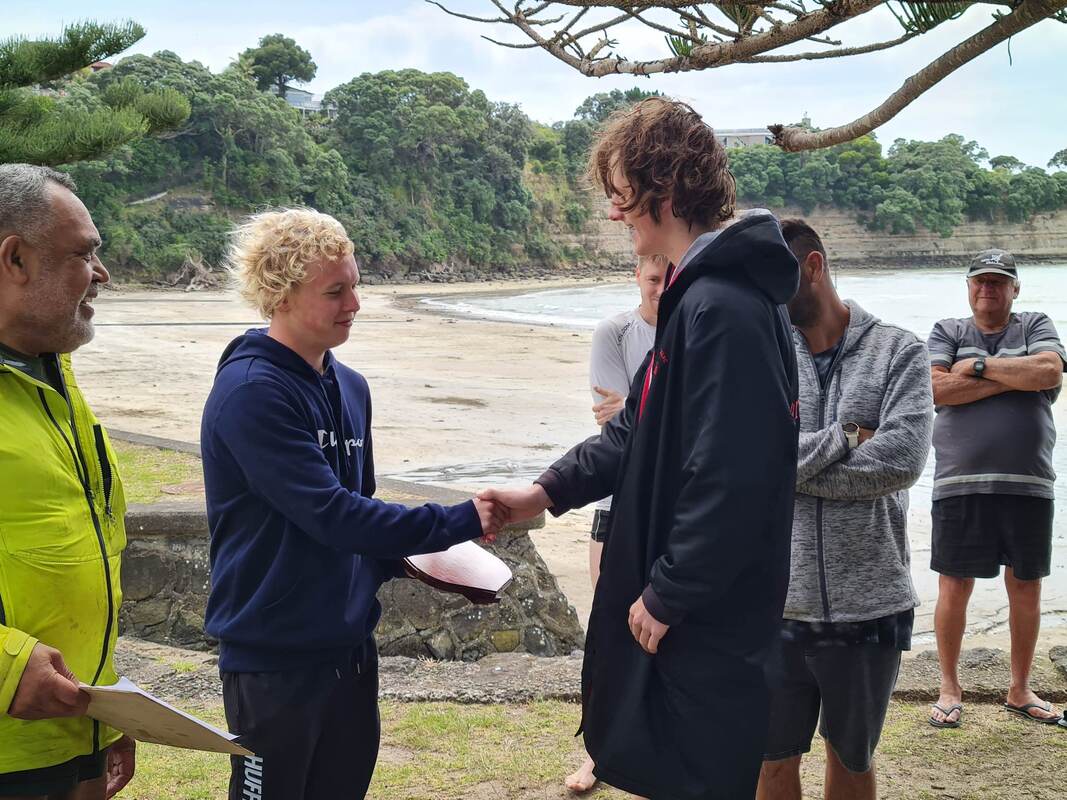
Throughout the rest of the day, I had haunting thoughts of where I thought I gave up. I remembered vividly where I let Robyn’s wheel go. The “ifs” and the “I could have” gave me grief. Then I remembered what it really means to be a loser. Losing is a negative term for learning. It means at the moment you encountered parts that you were not prepared for. It also means that you were someone completely different than who you are after that race or experience. After I returned home from Guam I listened to a podcast that featured one of my favorite cyclists, Paige Kostanecki. On Coffee and Van chats with Out Of Collective, she gives insight into how she approaches the start line. “Each time you line up for a race is special, it is a unique opportunity to show what you are capable of. The pressure of that opportunity will not break you, it will make you great. Feelings of anxiety is a good thing, it's your body’s reaction to being on the precipice of something exceptional. It will keep you alive, sharp, and hungry.” She goes on to how she prepares to win, and how it takes a ferocious appetite and commitment to the winning results. She mentions that sometimes we can “future trip” meaning we overstress what may happen in 5 years, 5 months or 5 minutes before the current moment. In the end she gave a solid reminder that “all we have is this moment”. At that moment, I was on my dream bike on a beautiful island. I was racing for the country of Samoa, pushing bike racing for the pacific nations. At that moment I did my best, and at that moment I achieved a finishing time of 1 minute over 4 hours and secured 5th place overall for Samoa. At that moment I had finished the hardest race of my career. Living in the moment is all we have, give your best and love every part, sometimes you win, and sometimes you learn. END 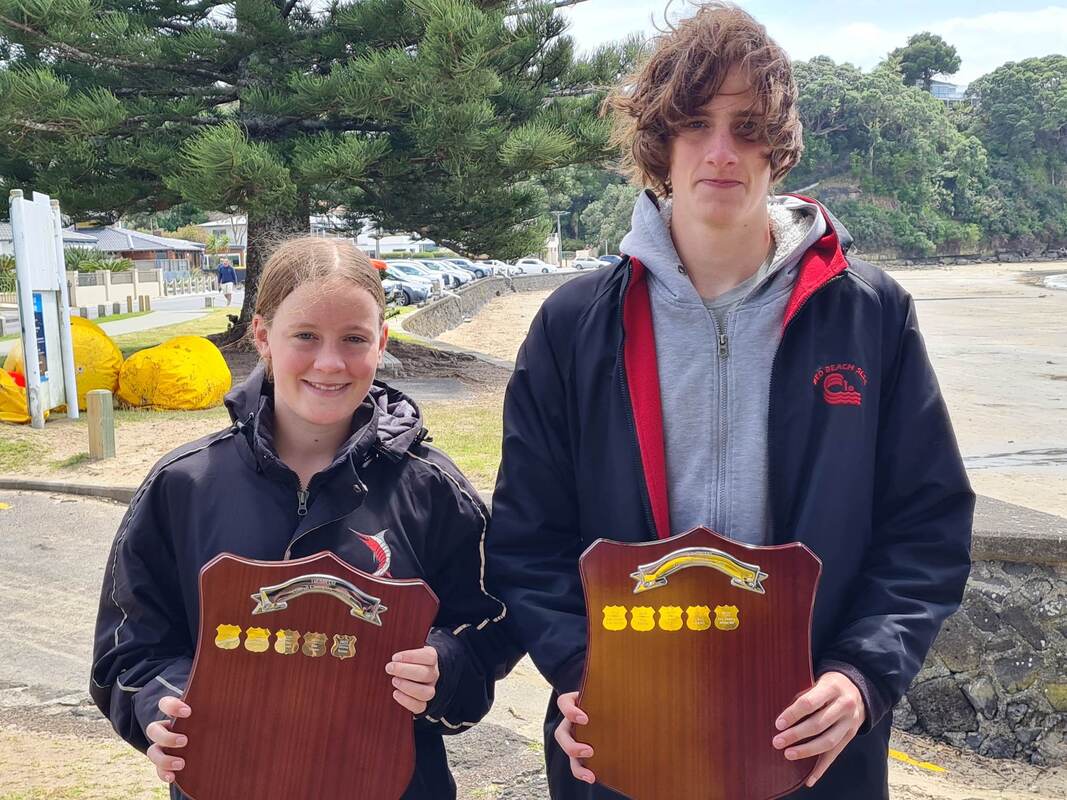 Twins Lena and Larn Hamblyn-Ough start the new year by winning the New Years Day Swim on the North Shore, Auckland. Photo by Ray Pichon. After four straight years of winning the New Years Day swim, it was time for Alex Dunkley to hand over the reigns to new champion Larn Hamblyn-Ough in the men's race. In the women's line-up, defending champion Olivia Bates handed over the women's shield to Lena Hamblyn-Ough. The race up front was tight and friendly between Team Auckland swimmers Alex, Olivia, Lena, Larn and Jack Potier. The team was race-sharp from competing in competitions in New South Wales and Queensland in December. Alex, without a wetsuit finished 20s behind overall champion Larn. Twin Lena finished fourth overall ahead of Samoa representative Palepua Afoa. The Hamblyn-Ough twins are dominating ocean swimming in New Zealand at present. Larn is also a national representative. He was part of the New Zealand team to the Pan Pac Games in Hawai’i in August. After two years of swimming around the reef at Browns Bay, the event this year returned to the traditional course between Long Bay and Browns Bay. The rough conditions had one advantage, the water was empty of jetskis and boats on New Years day. We did not encounter one craft on the course. Conditions were heave-ho in the 30 km breeze in the first half from Long Bay to Winstone Point and claimed one marker that swept onto rocks. Conditions settled a little in the second half of the swim between Winstone Cove and the finish at Browns Bay. There are nine swims in the Holiday series. The last swim is the Waitangi Swim on February 6. New Years Day Swim in photos - 1- Alex Dunkley hands over the shield to new champion Larn Hambly-Ough. 2 - First wave at Long Bay. 3 - Getting read for the swim. 4 - Team Seal - Troy Rangi, Tate Pichon and Joshua Vegar. Photos by Ray Pichon. Champions
Women 2018, Jen McDermott 2019, Terri Bidwell 2020, Ella Crowe 2021, Ella Crowe 2022, Olivia Bates 2023, Lena Hamblyn-Ough Men 2018, Alex Dunkley / Mike Cochrane 2019, Nick Shanks 2020. Alex Dunkley 2021, Alex Dunkley 2022, Alex Dunkley 2023, Larn Hamblyn-Ough For the full results, click here. 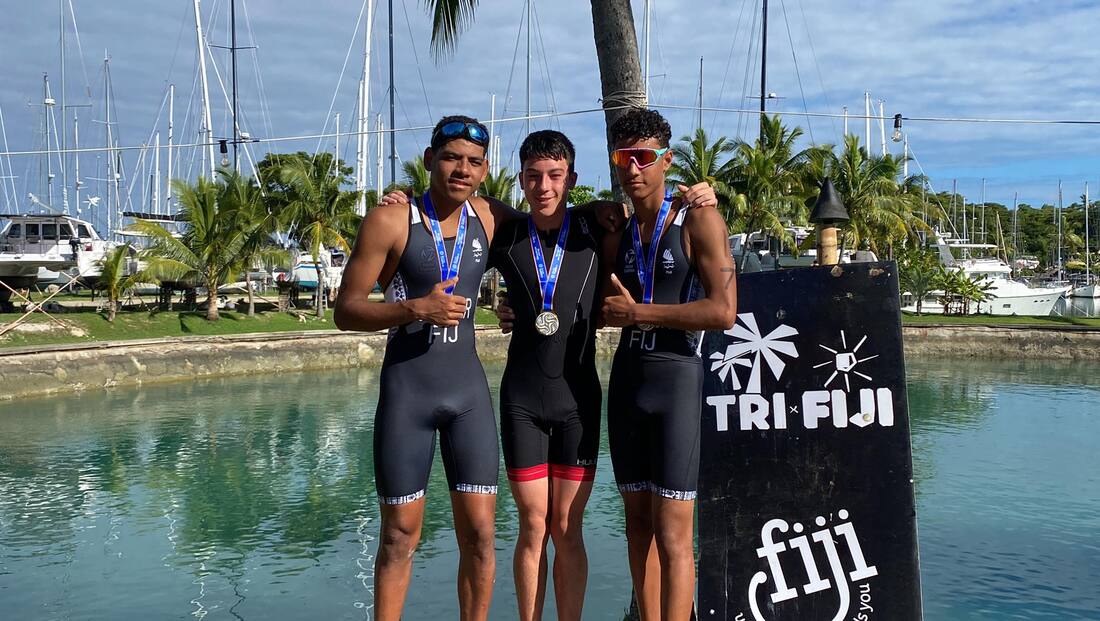 Jett of Samoa first ahead of Fiji’s Nikotimasi Croker and Christian Rokoua who finished second and third Samoa’s Jett Lee Curteis is Oceania Triathlon champion for 2022. Curteis claimed victory in the Oceania Pacific Islands Triathlon Championships that was held in Nadi, Fiji on Sunday. Curteis and team-mate Gideon Mulitalo took on the best of the Pacific from Papua New Guinea, Solomon Islands, Fiji and Tonga. Mulitalo finished sixth in the nine-man elite field. In the women’s elite race, Urlin Mulitalo finished seventh in her race. The Championships was contested in the Super Sprint triathlon distance of 400m swim, 10km bike, and 3km run. Curteis led the swim from the start to finish. In the bike leg, he lost a bit of time and was the third rider in transition. The run was a formality for Curteis who won the race by over two minutes. Fiji’s Nikotimasi Croker and Christian Rokoua finished second and third to round up the men’s podium. In the women’s race, Guam’s Manaima Iijima was too good for the rest of the field. Iijima races at a high level in the sport in the world circuit and it showed. Tahiti’s Maidi Susset finished second and Fiji’s Katie Pattie, third. 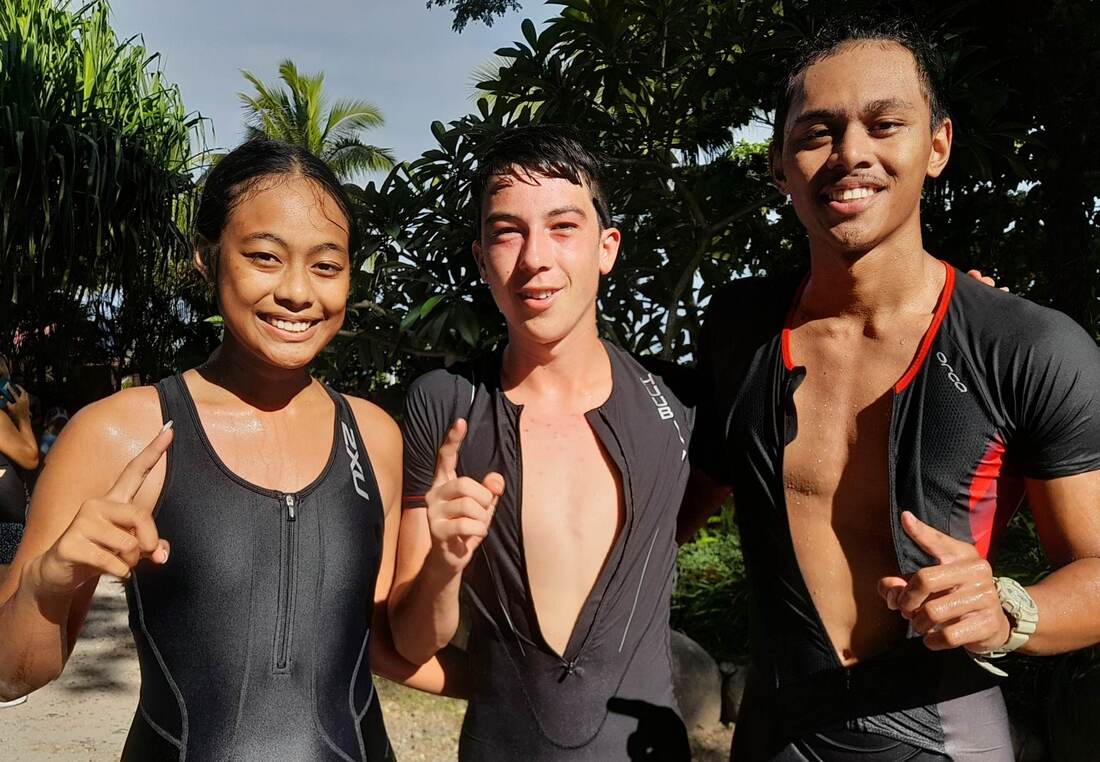 Team Samoa in Nadi - Urlin Mulitalo, Jett Lee Curteis, Gideon Mulitalo Curteis was a last-minute replacement for team Samoa when a team member from Apia pulled out within days of leaving for Fiji. Curteis took up the call from Samoa Triathlon President Seti Afoa to fill the spot. Curteis’ mother Lenora Lee is of the Lee family in Samoa, who encouraged her son to try out for Samoa. Jett had previously competed in Samoa Events ocean swim races in Auckland where the connection with Afoa and triathlon began. Curteis attends Westlake Boys High School in Auckland where he is a top runner for the school. He was competing at the NZ Secondary School’s national champs when he got the call for Fiji. “I was very happy to get the call up.” 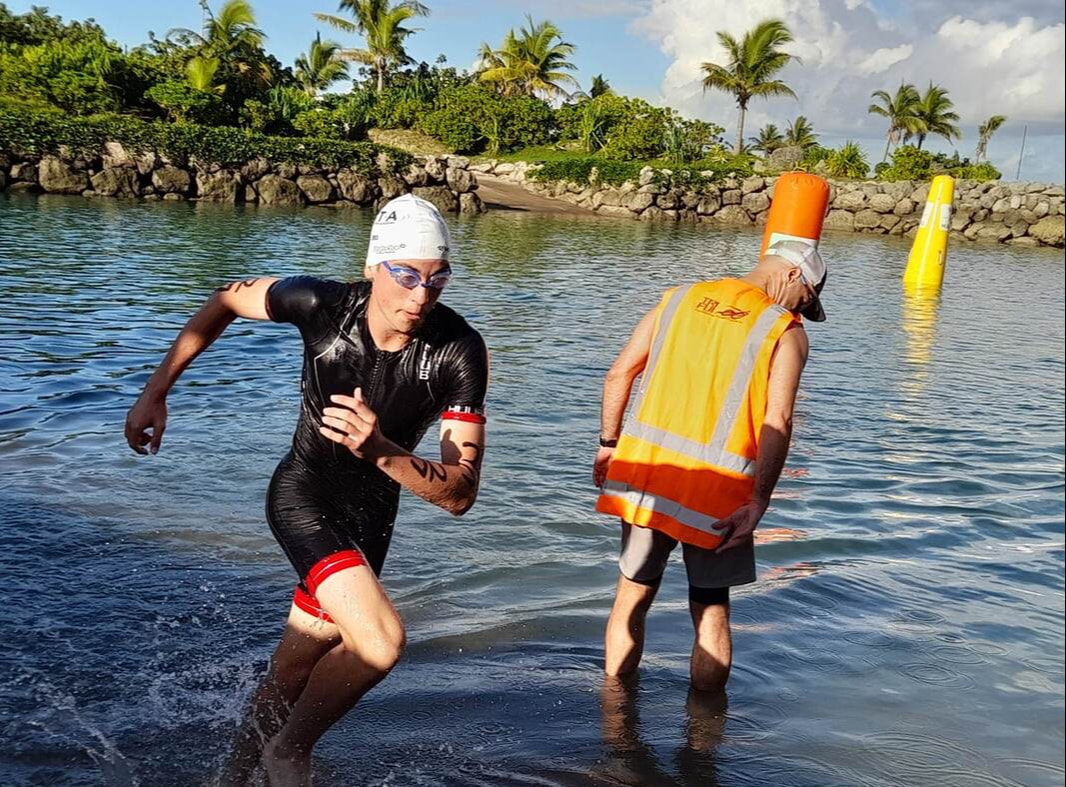 Jett was first out of the water The race in Nadi was also Curteis’ first triathlon event since aged twelve years when he competed in the Wheetbix Tri for kids. He had a race plan to make up for his lack of triathlon experience. “I’m very happy with the result but I think transitioning in and out of the bike, I need to get better at that.” “I knew the bike was my weak discipline, so I tried not to waste much energy on the ride,” Curteis said. There was a bunch of four athletes ahead of Curteis after transition and he had a plan to rein them in. “I tried to keep a pace where I wasn’t comfortable but also not sprinting. I held that for two laps and on the last lap to go a little bit faster and sprint more.” The race plan worked and Curteis is Oceania men’s triathlon champion for 2022. Curteis represents Samoa by way of Samoa Triathlon’s newest club, Māngere Cycling and Triathlon Club END 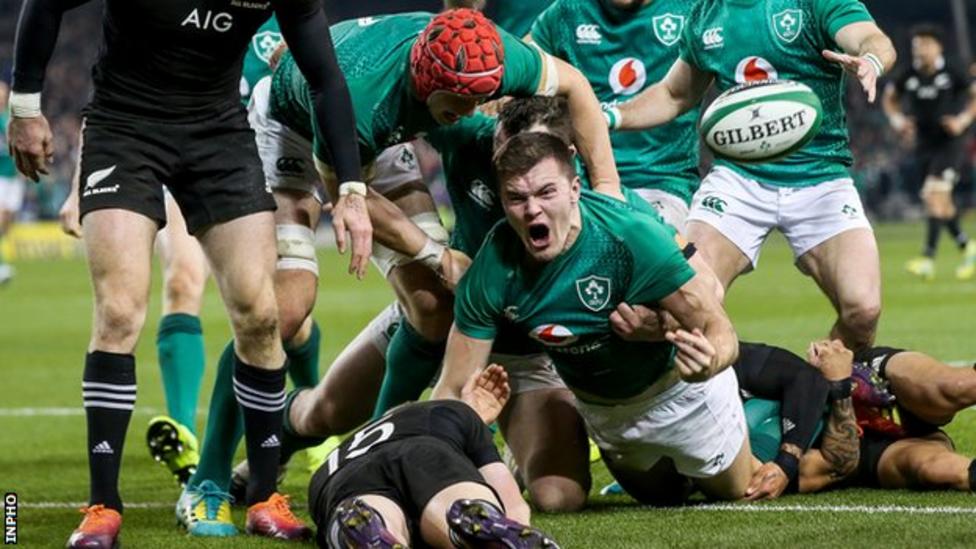 All Blacks loss at Aviva Stadium, November 2018. Photo, INPHO
It couldn’t have come sooner. The Irish are here in time for Matariki and a three test series against the All Blacks. It’s a timely change from the long-as inaugural Super Rugby Pacific ho-hum of a season. The rugby has been mediocre in many respects and outright boring at times. My, how things have changed. Ten years ago, the Irish were easy beats when they last toured in 2012. The All Blacks scored 124 points in the three-test series and Ireland managed a measly 29 points in all three games. Ten years later and it’s the All Blacks who are on the back foot. They have lost three times to Ireland in the last five test matches between the two sides. No one could have prophesied the turn in fortunes, not even a rugby psychic if there was one. I was fortunate enough to be at Aviva Stadium in Dublin to watch an Irish victory in November 2018. The All Blacks lost again last year, in the same venue, the last time the two sides met. I saw then the passion of the Irish. Not only the players, the fans too. There were 50,000 Irish playing the AB’s that night. The passion of the crowd is such that there is no anthem singer when Ireland plays. The nationalism and voice of the fans sends a vocal blast into the stratosphere with the sound of Amhran na blhFiann, the Soldier’s Song and you can hear the players sing their anthem with deep pride. The stadium is a cauldron of Irish fervour for the entire game, stirring the players on. Which is why there is so much interest in the upcoming series and the selection of the first All Blacks team of the year. Who will be named in Ian Foster’s side? The answer to that question is immaterial. It is whether the available pool of players contains the talent to match Ireland, in particular, the fowards. I am not convinced that is the case any more. The likely bunch will not strike much fear in any Irish heart. The names that have come to the surface after a long Super Rugby season are run of the mill players, none that stands out, particularly in the front row. All Blacks dominance of years past was built on a solid foundation of unmovable men in the front row. They are the cornerstone of the tight-five and the team. Now those players are found in other teams, including Ireland. Don’t get me wrong, AB’s coach Ian Foster will pick a good side, deserving players, the best of the lot. I’m just not convinced we have that many world class tight-five players of All Blacks teams a decade ago, and earlier. There are name players in Sam Whitelock, Brodie Retallick, Scott Barrett in the locks, and Ardie Savea on the flank. They are not the front five and Whitelock and Retallick are not at their peak. Sure, we have world-class backs in Beauden Barrett, Richie Mo’unga, Will Jordan and Rieko Ioane but rugby is won up front. Or has the sky truly fallen and the All Blacks are now perpetual mortals? The answer might just be far too obvious. My likely team Props: Nepo Laulala, Ethan de Groot, Ofa Tuungafasi, George Bower, Tamaiti Williams Hookers: Codie Taylor, Dane Coles, Samisoni Taukei’aho Locks: Sam Whitelock, Brodie Retallick, Scott Barrett, Josh Lord Loose Forwards: Ardie Savea, Marino Mikaele-Tu’u, Akira Ioane, Hoskins Sotutu, Dalton Papalii Halfbacks: Aaron Smith, Folau Fakatava, Finlay Christie First-fives: Beauden Barrett, Richie Mo’unga, Stephen Perofeta Midfielders: Jack Goodhue, Rieko Ioane, Quinn Tupaea, Roger Tuivasa-Sheck, David Havili Outside Backs: Sevu Reece, Jodie Barrett, Will Jordan, Caleb Clarke, George Bridge Two to be selected, one prop and a loose-forward.  I have long had a problem with the word "extraordinary". World Triathlon's rebranding came up with a new tagline, "Be your extraordinary". When I saw that, it took me back to 2014 and 2015 when Digicel Samoa (telco) used the phrase as their tagline: "Be Extraordinary". The problem, and it's mine alone, is the word extraordinary. In its simple form, it is asking me to be twice as ordinary. Suppose you dangle the word in front of a non-English speaker. That is exactly what it means to them. It makes sense too. Put the word "extra" in front of any descriptive adjective and it means you are twice as strong, brave, smart, intelligent and so on. So why is it different when "extra" and "ordinary" are put together? Even if English is your first language, the word's spelling is just that, extra-extra ordinary or twice as ordinary if not more so. But we speak of extraordinary as meaning out of the ordinary. It's a superlative of the highest order. But really, I would prefer instead the wording Not Ordinary.
For a whole two years and maybe longer, I used that tagline for myself in the face of Digicel's blanket coverage of their proud tagline. Everywhere you looked, there was a billboard exhorting Samoans and Pacific Islanders to Be Extraordinary, on television, in newspapers and on every online platform. It drove me nuts and extra insane, especially since Digicel sponsored everything else on the island except the amazing and not ordinary activities we were actioning. Like the 22.3km inter-island Apolima Strait swim, the Warrior Half Ironman race, the Samoa Swim Series, the 104km Perimeter Relay, Savai'i Marathon and more. Those were anything but ordinary activities. Like the Tokyo Olympics. How amazing was that? And how many times did you hear the word "extraordinary" being uttered or written to describe an out of this world performance by an athlete? Of all the superlatives, "extraordinary" was the most used. However, the message is clear or meant to be from World Triathlon for triathletes to go beyond being ordinary and reach their best. It is a great message, but from a non-English speaking perspective, the message is tainted. 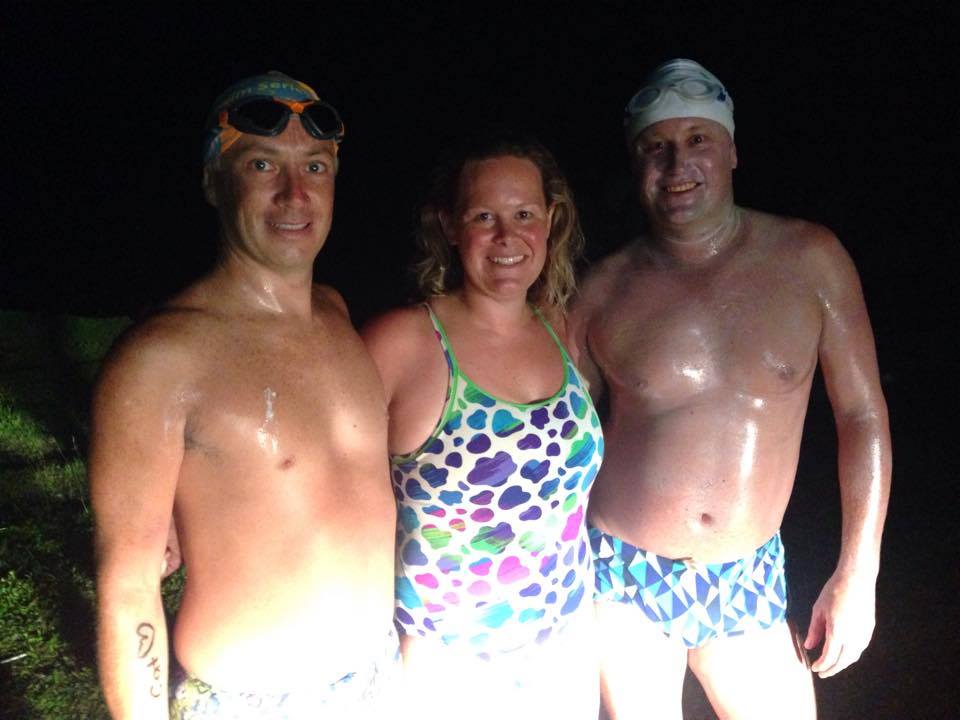 Mike Cochrane, Rosie Sharman and Kane Orr at 5 am before the Apolima Strait test swim. The story of the Apolima Strait test swim 2015 Mike Cochrane, Rosie Sharman, Kane Orr It was the perfect day for a swim and the worst day. We launched off at 5.23 am, off the ferry terminal at Mulfanua. The aim was to swim to Savaii 22.3kms away. Kane and Mike stuck together for the first hour until daylight and Rosie had a boat to herself. Each had kayak support and I was on the kayak for Mike. Kane had a boat to himself too, and Mike was a floater - actually he shared a boat with Rosie but you cannot contain Mike, he's a stronger swimmer than Rosie and he had me by his side. On Kane's boat was his wife Narelle and Pauline English who swam to Apolima Island the day before. That in itself is a huge feat. Dave Champion, Pauline's husband, was on the kayak for Kane. On Rosie's boat was Scotty Rowlands and the two boatmen with Shane Taivai Paulo on the kayak for her. Mike and I were on our own pushing on ahead with everyone in sight. The idea for the swim came from Kane. He is training for his swim across the English Channel. I wanted to help him achieve his goal of swimming to Savaii, but I then realised my timing was all wrong. The last thing I wanted to do after a busy Swim Series and Warrior Race was to spend a full day on the water on an inter-island 22km swim. The swim was meant for Monday 10th August but bad weather meant it was delayed. Mind you, after a torrid week of SSS events a full cancellation was a welcome relief. But I had made a commitment to Kane and I was going to see it through. It was good Mike and Rosie joined the swim. Finally, the weather forecast looked good for Wednesday. There was to be light winds all day and right through the day. Up to then everything was marginal - I even posited an alternative coastal 22km swim in the event of a full cancellation. But with the good weather forecast for Wednesday, I made the call for the full swim starting at 5 am. I was up at 2 am getting things ready and was at the swim site by 3.30 am. The two support boats arrived at Mulifanua Lodge where Kane and Mike and crew were staying, those were loaded with supplies. Still we were a bit late, starting 20mins behind schedule at 5.23 am. The morning was perfect, the sea was flat and a perfect day for a swim. The surprising thing was, Rosie led for the first 8 kms of the race. Mike and Kane exited the Mulifanua channel quite wide and lost ground from the start. Soon after daylight when I became useful Mike and I took off, Kane by that stage very early on in the swim had had several jelly fish attacks. He was in some discomfort. Mike also sustained some stinger attacks and felt numb around his face. Rosie seemed to have escaped it all. Kane fell back as Mike and I surged forward to catch Rosie. Mike's feeding schedule was every 20mins or at about 1.5kms intervals. From the kayak I directed the swim, and often called on Rosie's boat to ferry messages between the three groups. Soon after the start Rosie's boat veered right and was about a good 1km away and heading toward Russia. Several times I signalled over the boat, by raising the paddle high in the air to give instructions to pull Rosie to the left of the Ferry line - they were well to the right of that line. We kept on the left of the ferry line and kept to that until we caught up with Rosie and her crew. She was amazing and was going strong, as was Mike. Several reports back from Kane's boat indicated he too was going ok after the stinger attacks. At the 8 km mark we caught up to Rosie and passed her. By then too she was finally well left of the ferry line and in line with us. Mike and I pushed on. Conditions were perfect. The sun was already up. To our left was first the island of Manono, then Apolima seemed to have awoken from a long night's slumber as the sun's rays touched her Cone peaks. We were in swim heaven. 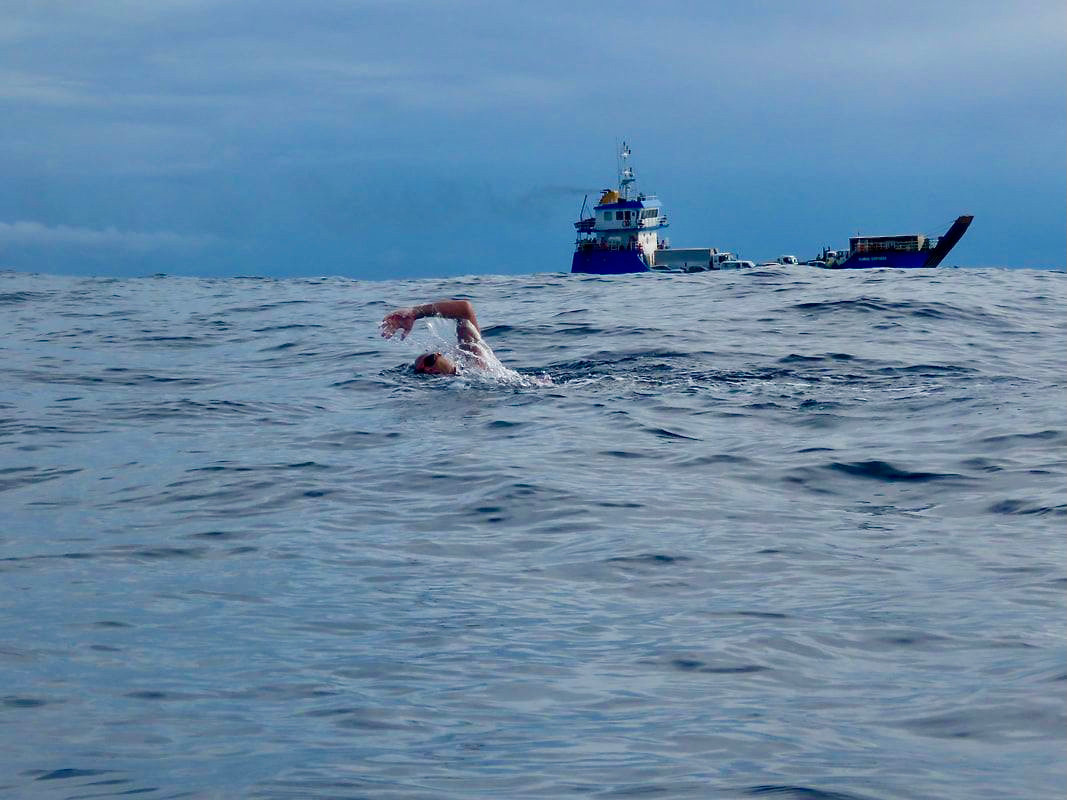 Mike and I are on the left of the ferry line. Mike reported fantastic underwater scenery of schools of tuna darting here and there, stacked several levels high in the water all the way to the surface. There was a lot of surface breaking by the fish and it made for interesting viewing from the kayak - but Mike had the better view. Mike also reported a huge coral shoot and could see the bottom. Later Rosie reported seeing tuna also, and a school of fantastic mantra rays way down below her. There were no signs of sharks. At 16.5 km and 6 km to go for Mike - 5hrs into the swim we had well passed Apolima island to our left. Salelologa, our destination was clearly visible and it looked like we will finish at around midday. Rosie was swimming strongly and still veering to the right but the message was loud and clear from me that she was to keep to the left of the ferry line. To help that I called over the boat again and insisted on Scotty Rowlands making the calls on the swim and not the boat captain. Scotty was the swim captain and told him he had to make the calls on direction and navigation. He did that well to the end. Kane's boat by this stage was a dot on the horizon behind us. Savaii ahead was a dark grey landmass with Mt Silisili the highest peak of Samoa way in the distance. From the 10 km mark parallel with Apolima that was an important landmark. We were to stay left of that, at about 11 o'clock from the top of Silisili. Then soon after the two prominent churches on the Salelologa side of the island were also great landmarks. We were to stay well left of those as well. The direct route was to aim for the headland at Tafua and just north of Apolima. That should get us to within the narrow Salelologa ferry channel for the final push to finish at the terminal. We powered on. Mike was a machine, and I could see Rosie to my right and rear also going strong. Then 5 km to go, and four, we were doing well. The finish was an hour away. My backside was absolutely sore by this stage 6 hrs into the swim. I called over Rosie's boat again and asked the crewman to take over on the kayak. I had wiggled on my seat for the last two hours and I was in danger of falling in the drink. I crawled onto Rosie's boat and then went back to her and Shane. The sea was amazingly flat and I took a video and photos of Rosie and promptly posted them on Facebook to satisfy the curiosity of friends following the swim from around the world. My rest was brief however, we looked over and the crewman had led Mike to the right and wider than Rosie all in a short time. So we shot over and swapped again, this time with the life jacket as seat cushion. I was vulnerable now particularly if I fell in. Soon after I got back in the kayak and with Salelologa wharf clearly visible, I could see the channel markers too - then the heavens opened and the rain came down. The wind beat up and the waves rose all around us. I could see Rosie's boat behind us about 2 km away but the land ahead disappeared in the rain cloud and we lost all landing reference. Mike and I were now close to the breakers and even from that distance we could not see land. This was a whiteout. I was a bit nervous. The narrow ferry channel was nowhere to be seen. You can see the finish conditions in the photo where Rosie exits the water. This turn of bad weather was not in the forecast. It came as a total surprise to Mike and me. We both had the same weather readings for the day. 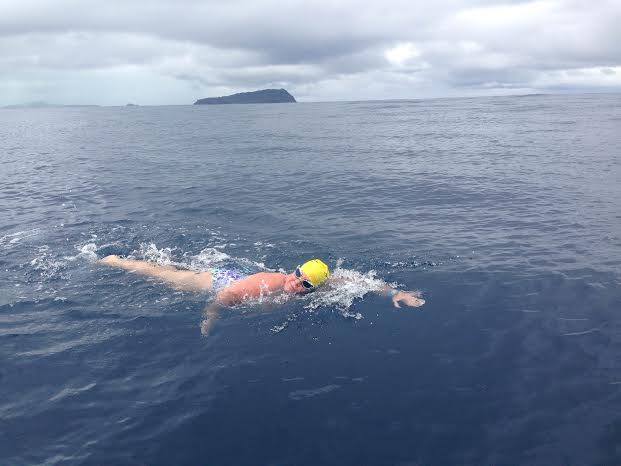 Flat conditions for Rosie we can see the finish. The sea was now rough and the 5 km per hour wind became 25-30 km per hour. As many know the sea outside the ferry terminal channel is ferocious where the reef acts as protector from the prevailing surging current. It was even more so now. But where was the channel? I kept Mike on sight and paddled left to look for the channel. None. Finally I went back to Mike who was swimming amazingly in the swell and he and I had a meeting. We will wait for the 12 pm ferry to go by to see which way it entered the channel. Fortunately we only waited about for about 10 minutes before the ferry came streaming through from Mulifanua / Upolu. It lined up for its approach to Salelologa and entered the channel. We were a good 1 km away from the channel. How quickly we had drifted. I then paddled and Mike swam behind me for 20 minutes to reach the channel. The sea was a heave-ho. Land could not be sighted still but least we had an idea where the channel was, so I thought. We got there and I took a wrong turn thinking this was the channel. I paddled right through the heaviest of swells and breaking blue waves, had my iPone in my shirt, my camera around my neck and I was totally soaked. I was surfing huge breakers with no lifejacket. How I did not fall in can only be put down to divine intervention. Earlier I had remembered my mother, and sang one of her favourite hymns as I was bobbing up and down behind the breakers - Iesu e, Tautai lo'u Va'a - Lord, You be the Pilot! Now through the breakers I looked behind me and Mike had made it through as well. Only then did I realise that the channel was further to the left about another 200m. Never mind. We are almost there. The rain now also dissipating and the bright orange ferry building is now in view. We have broken through the mist barrier. The finish was only 500m away. There was a reef to negotiate and still rough sees and strong cross winds between us and the ferry terminal. I couldn't see the other two boats behind us now but not for long. To our left and in the channel Kane's boat came through and quickly, meaning he was not swimming. Then Rosie's boat came into view, she was 30mins back but least she also had made it through the channel. Kane's boat came alongside just before we got to the ferry landing and anchored to our right. It was hard paddling that last 200 or so yards. Mike was just behind me. The 2 pm ferry was loading as we made our approach. Finally we were there. Mike touched ground, got out of the water and looked very pleased with himself. And so he should. He had swum 24kms in just over 8 hours. Epic stuff. 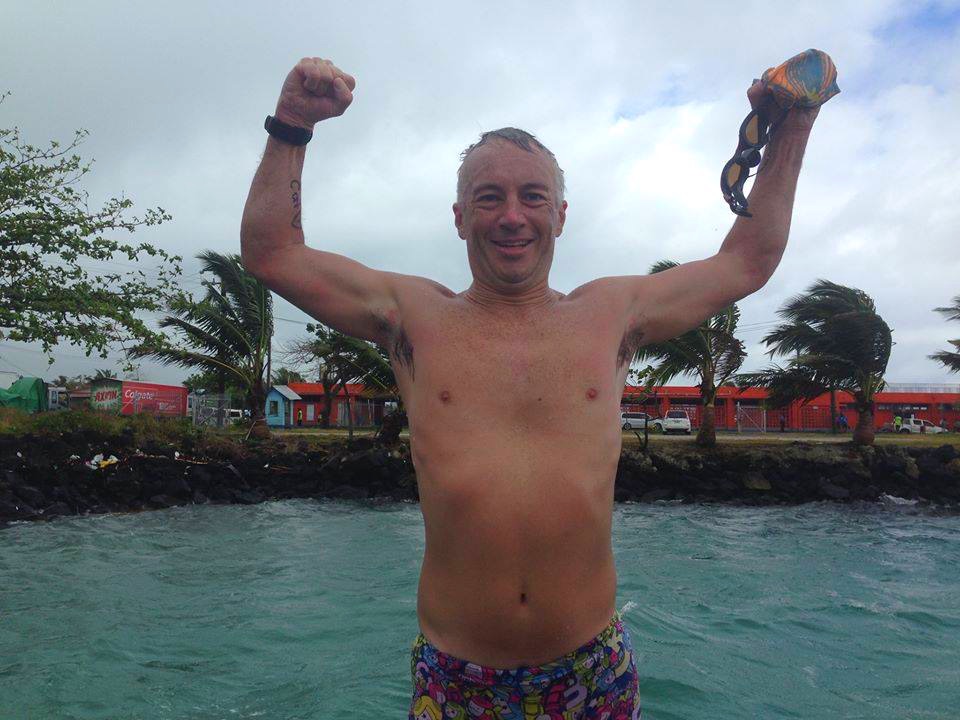 End of the swim for Mike, notice the wind effect on the coconut trees. Sure enough Rosie was 30 minutes exactly behind us and she powered to the finish. Her boat entered the reef 1 km away from the channel. That is where local expertise counts. Rosie's Her total was 26 KMS distance covered, that's because she was wide early on in the swim. Rosie however had the faster swim rate to Mike but Mike and I covered less ground/water to Rosie. This girl is amazing. She is white gold. She touched ground and exited the water to give Mike a big celebratory hug. By then Kane, Narelle, Pauline and Dave scrambled ashore to purchase tickets to catch the 2 pm ferry back. The three of us and our crews meanwhile were celebrating Rosie's achievement with howls of our own to add to the howling wind and rain. This was a Life moment. She had only just swum her longest swim a week before in the 10 km swim. This achievement is amazing and she deserves every accolade. Is she the first woman to swim to Savai'i ? We're trying to find out, but likely she will have that honour of being the first woman to make the crossing and fittingly so. I was gutted for Kane, his next goal is to swim the English Channel in Aug 2016. This is how these things pan out, it is not all going to go your way all the time. As for Superman Mike, the guy is a Swim god. When things got rough and we were lost, there was no better person to be in the water with than Mike. 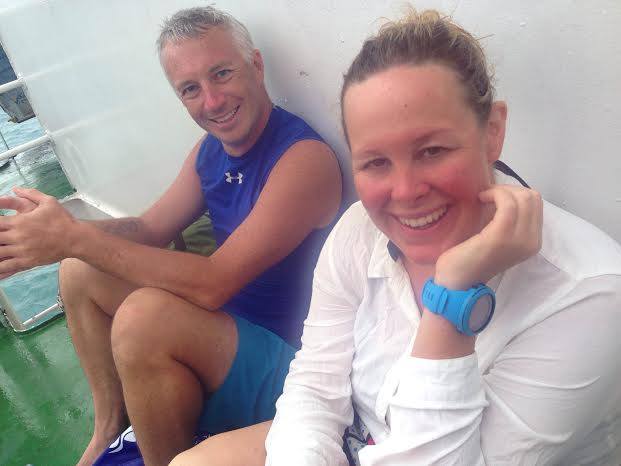 Mike and Rosie on the return ferry to Upolu on the same route they had swum a few hours earlier. After our celebrations I then asked the boats to drop us off at Lusia's where only a week ago we had had lunch after SSS 2. We were back there, soaking wet, but happy and high in our own euphoria. We had beaten the elements.
After our lunch of fish and chips we then taxied over to catch the 4 pm ferry. The ride back was interesting on the same route the swimmers had swum only a few hours earlier. It was rocking and rolling most of the way - This was a truly Jekyll and Hyde experience - and we survived to tell the tale. (Thanks to Robbie for the title of this piece and borrowing from Dickens for the opening line). 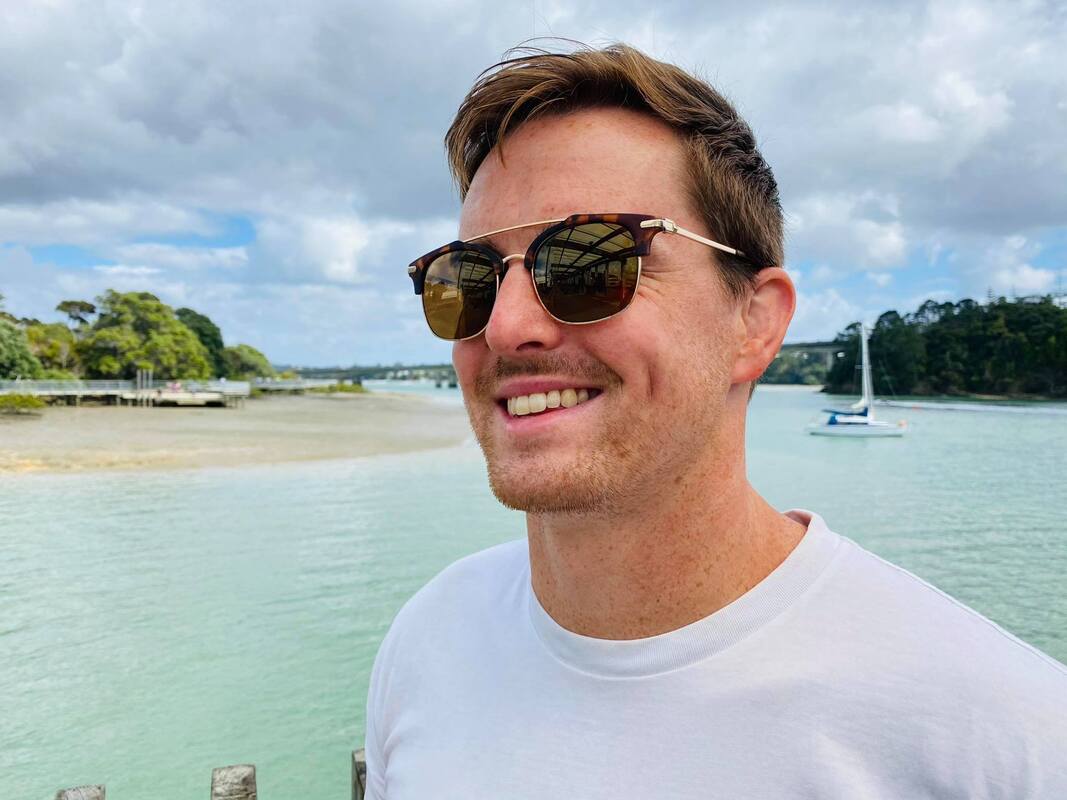 Jono at Hobbie Point. Photo / @SamoaSwim Profile Jonathan “Jono” Ridler Age, 31 years Grew up in Lynfield, Auckland School, Hebron Christian College, and one year at Auckland Grammar Work, Client Operations Manager, Fliway Every time Jono’s phone rings in the next few days, it could be the call from his boat crew to get himself to Invercargill for his swim across Foveaux Strait. Within forty-eight hours of getting that call, Jono will be in the water swimming. He is on full alert and soon he will take on the most feared ocean swim in New Zealand. When he crosses the finish line, he will complete the NZ Triple Crown of Marathon Swimming, inside two years. That in itself is a remarkable feat. Jono swam Cook Strait in February 2019, twelve months later on the 29th of Feb 2020 he swam Lake Taupo. And now, he is on the cusp of adding Foveaux Strait to his impressive list of achievements. The Foveaux Strait Swim (28km) forms the big three of open water swims in NZ that includes Cook Strait (22km) and Lake Taupo (40.2km), and yet, whereas 130 swimmers have crossed Cook Strait, only eight swimmers have swum Foveaux. The Strait is not for bunnies, you have to be next-level off the boil, or beyond the boil to take it on. Even Jono himself outright rejected the idea of swimming it when a friend dropped a hint, as friends do. “No way.” That was his immediate and emphatic reaction to the suggestion. “Foveaux scared me, at the time it really scared me because of the cold, that was the big factor. It scares me less now. But I have always leaned toward things that I feared and that has led to Foveaux.” “You can count on two hands the number of people who have swum Foveaux, that speaks to a couple things. One, it’s a hard swim, second, there isn’t a lot of infrastructure around the swim, you can’t just call someone up anyone and say you want to do that swim in a couple of years. All the logistics need to be put together from scratch.” The suggestion to swim Foveaux was made after his crossing of Cook Strait. Jono has one of the fastest swim times for the Strait finishing the swim at 6hrs22mins01sec. That is the 8th fastest time since the first crossing in 1962 (Barry Davenport). When he was preparing for the swim, Jono found out that he wasn’t the first family member to cross Cook Strait. His dad Gordon had rowed across it with the Muriwai Surf Life Saving Club in 1969 long before Jono was born. After Cook Strait, Jono set his mind on the next challenge and that was swimming the 40.2km of Lake Taupo. He did that in a time of 12hrs22mins, again, one of the faster times for Taupo. Jono started to think more about Foveaux after Taupo and set out to piece it all together. He has put in some serious training for the swim. Over the last two months, he has been alternating between sixty and twenty-five km per week. He calls it bulking week and the recovery week, in the bulking week he “smashes the KMS” then bring it down the next week to give the body a chance to recover. The aim was to double the distance of Foveaux Strait on the peak weeks. Now that he has built up the miles, the next goal is to think about the time he is targeting for the swim. “It’s always so hard to say because it really is dependent on conditions on the day. I would love to give the time record a go, but anything can happen on the day, but at the moment I’m targeting the record.” That record belongs to Chloe Harris of Christchurch who swam Foveaux in February 2016 in 8hrs30mins. The other standout point of Chloe’s swim is Foveaux was her first swim of the Triple Crown, Cook Strait, and Taupo came later. That is the type of challenge that captures Jono’s attention and Chloe’s swim time is one thing he can focus on. “I want to give it everything I’ve got and do it as quickly as I can, that’s what my training has been geared around to hold a consistent pace and working on my top-level speed as well as my endurance speed in training which will impact my overall speed.” The biggest factor will be the water temperature which will sit around 14 degrees Celsius. Jono has left nothing to chance. As well as swimming through the winter he built his own chest freezer ice-bath where he put silicon around the edges and added a digital temperature controller and a water filter. He has three sessions a week in the ice-bath for an hour at a time. On the day we met, he was planning on a ninety-minute session later that morning with the temperature set at 7 degrees Celsius. For this session, he set up his TV to watch a movie, and every five minutes he will immerse his head in the water to get a sense of what that feels like. “I think that will really help. Through the winter I did a tremendous amount of training in the cold, it was really tough, culminating in a 5-hour swim at about 13 degrees C. I was pretty happy about that at the time.” There may be a silver lining, one of his skippers told him last week that he has seen some bluefin tuna in the Strait. It’s a good sign because the fish apparently only appear when the water reaches 16 degrees. The skipper said that he had recorded some spots in Foveaux recently at that temperature. Jono is not concerned about what the temperature will be on the day of the swim. “You can’t control what the weather is doing, but you focus on the controllables like training, adaptation to the cold, pulling together your team and crew.’ He has put together a great crew. The pilot and boat crew is a father-son duo who fish in the area. The son has 30 years of experience and the father 50 years of local knowledge, they know the Strait well. The Oreti Surf Club is providing an IRB. On the boat as the neutral observer for the swim – a requirement in ultra-marathon swimming – will be Simon Olliver who swam the Strait in February 2017. The swim direction is unknown at this stage but is likely to be south to north, leaving off Saddle Point on the northeast part of Stewart Island and finishing on the back of Bluff hill. That was the same direction and starting point for Simon and Chloe. The reason for the S-N course is because there has been very good success in navigating the tides in that direction. 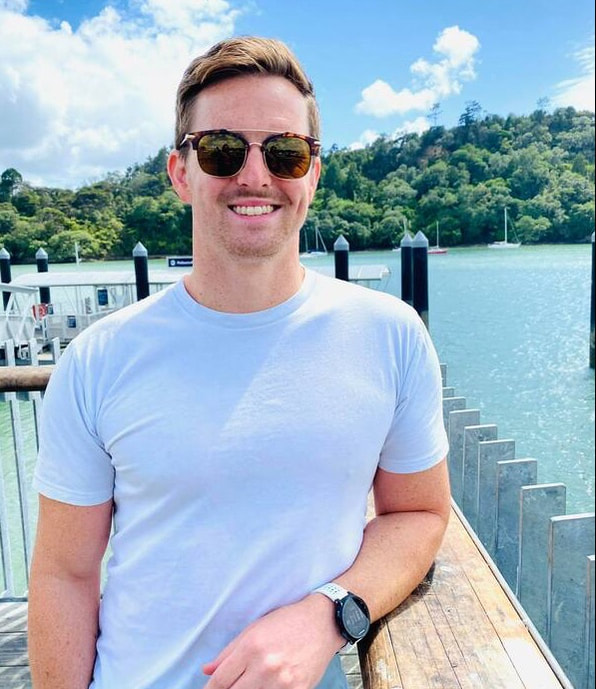 Jono is a regular participant at O Swim events Jono has done his research, “If you time the tide right, I will start the swim in the last two hours of the flood tide, then in the middle of the Strait it’s flowing east to west with no real tidal advantage or disadvantage, it's more how you point yourself at that stage. The final stage is trying to find a suitable and safe landing point on the shore. At that stage, I will probably be towards the end of the second tide, the last of the ebb tide.”
It will be the successful end of ten months of careful planning. The measure of success for Jono will be achieving a personal challenge that also brings rewards. “You have to put in the yards in training to get your body in shape, but you have to be really tough in your mind as well. There’s that part of it; the other part is there is a crossover with swimming and other areas of life. It gives you a lot of self-confidence to take on other challenges. There’s a lot of parallels that I find now with other things like business or relationships with what I’m doing now. Lastly, and more importantly, I’ve seen as a result of things that I’ve taken on has inspired other people to take on similar challenges. That’s been really cool to be able to see that what I’m doing is having an impact and being able to guide others from my experience. That is very rewarding for me.” Swimming wasn’t Jono’s first love. He grew up playing tennis and football and dabbled in running. He was training for a marathon in 2014 when he got a nasty case of Patellofemoral Pain Syndrome (PFPS) that developed into other injuries. That’s when he retired from football and gave up running and started to focus on swimming. In 2016 he swam his first 10km distance. Jono came to like swimming long distances and he began to wonder what he could do next. That led to a chat with Philip Rush, and Jono soon signed up to swim Cook Strait. From there, everything fell into place. "I always wanted to do distance endurance stuff. I thought it would be running but it was not to be." We wish Jono well on the swim. We will talk with him again after Foveaux and we look forward to bringing that report. End |